
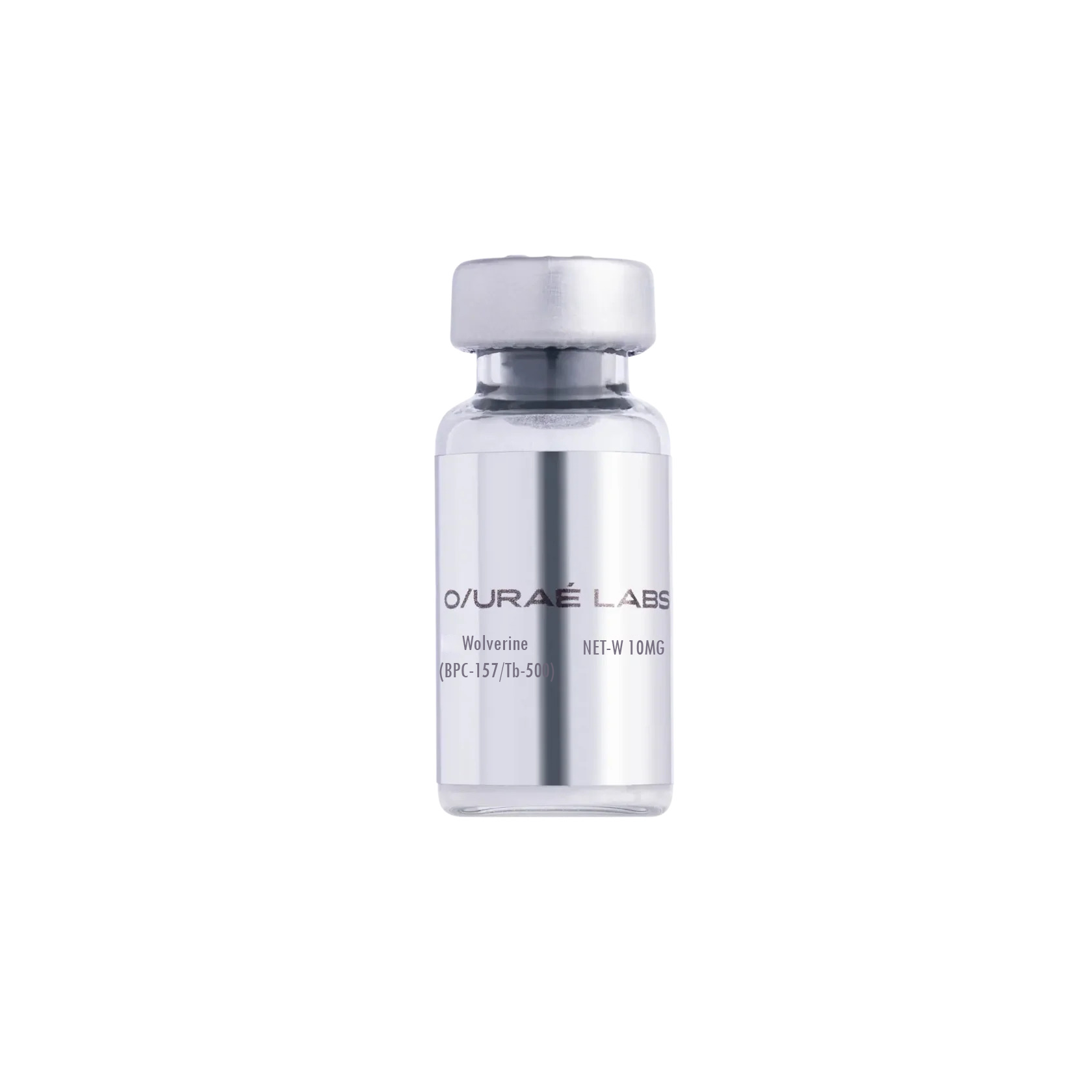
BPC-157/TB-500(WOLVERINE BLEND | Wolverine Blend (BPC-157 + TB-500): Research
DESCRIPTION
The Wolverine blend is a pre-formulated research combination of BPC-157 (Body Protection Compound-157) and TB-500 (Thymosin Beta-4) — two of the most extensively studied tissue repair peptides in preclinical research. The rationale for combining these compounds is mechanistic complementarity: BPC-157 primarily drives angiogenesis, cytoprotection, and growth factor receptor upregulation, while TB-500 operates through actin cytoskeletal regulation, cell migration, and differentiation — together addressing the two primary axes of tissue repair biology.
The combination has been studied across multiple tissue contexts:
- Tendon and Ligament Healing: Both peptides have individually demonstrated accelerated tendon healing in rodent models; their combination is hypothesized to provide additive effects through parallel angiogenic (BPC-157) and cellular migration (TB-500) pathways.
- Muscle Repair: TB-500’s actin-binding activity supports satellite cell activation and myofiber regeneration, while BPC-157’s NO modulation and VEGF stimulation support the vascular repair critical for muscle healing.
- Gastrointestinal Repair: BPC-157’s primary discovery context involved GI cytoprotection; TB-500 has more limited GI research but demonstrates synergistic potential in models of mucosal repair.
- Cardiac Research: TB-500’s epicardial progenitor activation and BPC-157’s anti-inflammatory cytoprotection have been studied in parallel cardiac injury models.
The individual components are also available as standalone products: BPC-157 and TB-500 (Thymosin Beta-4). For protocol guidance on using combination peptides, see our Stacking Peptides Research Guide.
Research Context: Wolverine Blend in the Tissue Repair Research Landscape
The tissue repair research space includes several approaches across healing biology. The Wolverine blend represents the most comprehensive pre-formulated option:
- Wolverine Blend (BPC-157 + TB-500) — Combination stack; angiogenic + cytoskeletal tissue repair coverage, most studied pair in regenerative peptide research
- BPC-157 — Standalone; VEGF/NO cytoprotection, GI and musculoskeletal research
- TB-500 (Thymosin Beta-4) — Standalone; G-actin sequestration, cell migration, cardiac and connective tissue repair
- Thymosin Alpha 1 — Thymosin superfamily; immune modulation focus (distinct from TB-500 structural role)
- AOD-9604 — hGH fragment; metabolic/lipolytic research (different healing context — adipose remodeling)
BPC-157 (Body Protection Compound-157) is a synthetic pentadecapeptide (15 amino acids, sequence GEPPPGKPADDAGLV) derived from a naturally occurring protective protein found in human gastric juice.
BPC-157 shows robust, reproducible tissue-protective and healing properties across diverse tissue types. Its strong safety profile and multi-system efficacy support advancement to human clinical trials.
It has been extensively studied in preclinical models for its remarkable tissue repair, cytoprotective, and wound healing properties across multiple organ systems. BPC-157 acts primarily through upregulation of vascular endothelial growth factor (VEGF) and modulation of the nitric oxide (NO) system.
BPC-157 demonstrated consistent wound healing acceleration across tendons, ligaments, muscle, nerve, bone, and GI mucosa. Promoted angiogenesis via VEGF, protected against NSAID and alcohol-induced gastric damage, and showed dose-dependent healing effects with no identified toxic dose (LD-1 not established).
Tendon, Ligament & Muscle Repair
BPC-157 has demonstrated accelerated healing of tendons, ligaments, and skeletal muscle in numerous preclinical studies. It promotes tendon-to-bone healing, increases collagen organization, and restores mechanical strength to injured connective tissue more rapidly than controls.
Nerve Regeneration & Neuroprotection
Research has shown BPC-157 promotes peripheral nerve regeneration and provides neuroprotective effects in CNS injury models. It has accelerated recovery from sciatic nerve transection and shown benefit in models of traumatic brain injury and spinal cord damage.
Mechanism of Action
Promotes Schwann cell proliferation and axonal sprouting through VEGF and NGF pathway activation. Modulates the NO system and GABAergic transmission to provide neuroprotection against excitotoxic damage. Enhances blood flow to damaged neural tissue through angiogenic mechanisms.
The Wolverine protocol combines BPC-157 and Tb-500, two synthetic peptides that are widely studied for their roles in tissue repair and recovery. These peptides are often researched together to explore their potential synergy in cellular and biochemical studies.
Rezensionen
Es gibt noch keine Rezensionen.